

How does a UFO work?
A Soviet Engineer Detailed Reverse-Engineering of a UFO on Paper in the 1980s. The Papers, Discovered in 2024, also Revealed that Pentagon Started Funding the Same Architecture in the 2000’s.

The Černohajev manuscripts describe a fusion-powered, turbineless, exhaustless vehicle. Decades later, ARPA-E and DARPA are funding programs that share its specific technical fingerprints.
Document version: May 2026
Companion archive: cernohajev.omeka.net
Canonical Source: Engineering Infinity: Earth’s First Interstellar Blueprint (Černohaev, V., Sticco, G., Černohaeva-Sticco, N., Fialho, M., 2024)
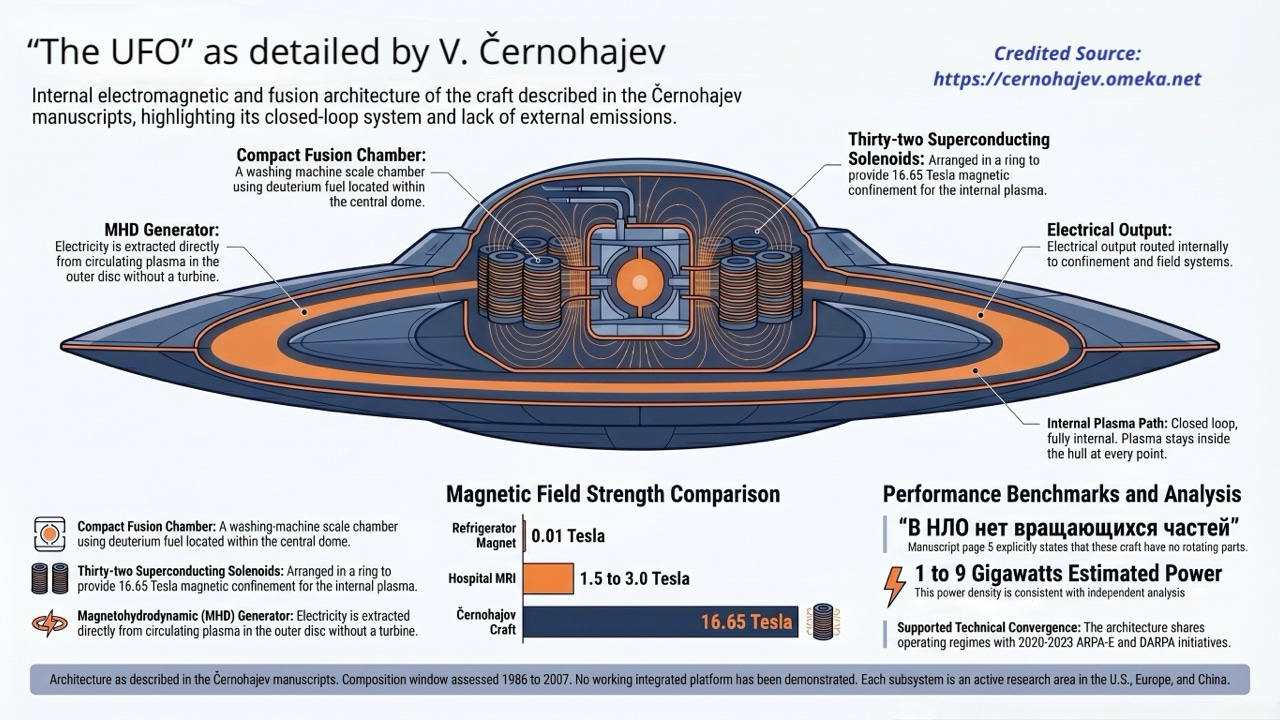
Bottom line up front
The vehicle described in the Černohajev manuscripts is, in essence, a small fusion power plant fused to its own engine, with no spinning blades, no jet exhaust, and no rocket flame. It runs on the same kind of fuel that powers the Sun, contains that fuel inside an invisible magnetic cage, and converts the resulting energy directly into electricity and thrust through a process that has no moving parts in the way a turbine or propeller does. The manuscripts treat the design as an engineering integration of established physical principles, pushed well past current human engineering capability rather than invented from exotic new forces. The performance envelope it implies has architectural similarities to what U.S. Navy pilots have described in the well-documented military encounters of the past two decades.
A different kind of vehicle
Most of the flying machines people are familiar with work the same basic way. A jet engine sucks in air, burns fuel, and pushes hot gas out the back. A rocket carries its own fuel and oxidizer, burns them, and pushes hot gas out the back. A propeller drives a fan that pushes air. All of these involve burning a chemical fuel, and all of them rely on something spinning very fast.
The craft described in the Černohajev manuscripts does none of those. It carries no chemical fuel, no turbine, no propeller, and no large rotating parts. The author is explicit on this point. On page five of the canonical PDF, in a handwritten note next to a piston schematic, Černohajev states plainly that UFOs have no rotating parts, and that this is precisely why the design uses a piston system paired with a magnetohydrodynamic generator instead of a conventional engine.
This single design choice has consequences that show up everywhere in the eyewitness record. Without a turbine there is no compressor howl. Without combustion there is no hot exhaust plume for infrared sensors to lock onto. Without aerodynamic control surfaces there is no need to bank, pitch, or yaw the way a conventional aircraft does. Pilots like Commander David Fravor describe Tic-Tac-shaped objects that hover silently, accelerate without exhaust, and maneuver without any visible flight surfaces. The Černohajev design, on paper, is consistent with those reported characteristics.
How the power plant works, in four steps
The propulsion architecture in the manuscripts breaks into four functions. Each one rests on physical principles that are independently published and well understood. What the manuscripts propose is an engineering integration of those principles at extreme parameters, well beyond anything that has been demonstrated in a sustained, vehicle-scale system to date.
Step one: a tiny star, on demand
The fuel is hydrogen, specifically the heavy form of hydrogen called deuterium, sometimes paired with lithium-six. These are the same ingredients that power thermonuclear weapons and the same ones that the international ITER project is trying to use for clean fusion energy. When two deuterium nuclei are forced together hard enough, they fuse, release a burst of energy, and produce helium and a free proton. The Sun does this continuously in its core. The Černohajev design proposes doing it inside a chamber roughly the size of a household washing machine.
The trick is forcing the nuclei together hard enough. The manuscripts describe two compression methods working in tandem. A piston system, alternating between two cylinders, pumps the deuterium fuel up to staggering pressures, on the order of twenty thousand atmospheres or more. Magnetic mirror traps, formed by superconducting solenoids, confine the resulting plasma so that it stays hot enough and dense enough for fusion to ignite. The fuel itself is selected with a specific constraint in mind: the manuscripts deliberately favor reaction pathways that produce fewer neutrons and gamma rays, on the explicit grounds that a craft carrying living crew needs to minimize radiation shielding mass.
This is not new science in the sense of unknown physics. Inertial confinement fusion, magnetic confinement fusion, and high-pressure plasma physics are all active research fields with billions of dollars of public investment behind them. What remains unsolved is the engineering question of compact, sustained, vehicle-scale fusion. The manuscripts describe a specific integration of these techniques sized for a vehicle rather than a power station, and that integration is at parameters substantially beyond anything currently demonstrated.
Step two: a magnetic cage, made of pulsed current
A plasma at fusion temperatures, tens of millions of degrees, will instantly melt any physical container. The only way to hold it is with magnetic fields, because the charged particles in a plasma curve when they cross magnetic lines. The manuscripts specify thirty-two solenoids, the cylindrical electromagnets familiar from any high school physics demonstration, arranged to produce a sustained field of sixteen and two-thirds tesla. For comparison, a strong refrigerator magnet is a few hundredths of a tesla. A medical MRI machine is one and a half to three tesla. The fields described here are roughly five to ten times stronger than a hospital MRI, sustained continuously, in a vehicle.
The 16.65 tesla figure is worth flagging because it sits in the same operating regime as a U.S. government-funded fusion program that came online a generation later. The ARPA-E WHAM program, which began funding in 2020, uses the same magnetic mirror architecture and operates in a comparable field-strength range. The convergence here is architectural rather than predictive: the Černohajev manuscripts describe an engineering approach that U.S. funded research has independently arrived at. The manuscripts predate the WHAM funding announcement by a substantial margin. ASIRP classifies this as a “supported but not confirmed” convergence under ICD 203 analytic standards, the same confidence vocabulary used in formal U.S. intelligence assessments, rather than a confirmed lineage.
Step three: turning fusion energy into electricity, without a turbine
This is the part of the design that most clearly distinguishes the Černohajev craft from any conventional power plant. In a normal nuclear reactor, the heat from the reaction boils water, the steam spins a turbine, and the turbine spins a generator. There are huge moving parts everywhere.
The manuscripts use a different technique called magnetohydrodynamic generation, or MHD. The principle is straightforward. When a stream of electrically charged particles, such as the plasma exiting the fusion chamber, flows through a magnetic field, an electric current is induced directly in the flow. Pickup electrodes on either side capture that current. There is no turbine, no rotating shaft, no mechanical bearings. The plasma is the moving conductor, and electricity comes out the sides.
A useful mental picture: imagine pouring saltwater through a tube that runs between the poles of a strong magnet. The water itself becomes a current-carrying wire as it moves. MHD does the same thing with plasma instead of saltwater, and the energies involved are vastly higher. The manuscripts also describe a parallel scheme for capturing the positively charged products of certain fusion reactions, essentially harvesting electrical charge directly from the reaction byproducts before they leave the system.
The output of the MHD generator and the magnetocharge collector together feeds two things: the giant solenoids that maintain the magnetic cage, and the propulsion system itself.
Step four: thrust without exhaust
This is the part of the design where the recovered manuscript record is most fragmentary, and any reconstruction therefore remains provisional. The thrust formulation appears in Work №2, beginning around PDF page 40, and the page that contains the continuation of the thrust derivation is missing from the recovered corpus. What is preserved indicates that the propulsion approach is electromagnetic rather than chemical, that it relies on directed plasma flow shaped by the same field architecture used in the reactor, and that it routes through a de Laval nozzle, the same converging-diverging geometry used in rocket nozzles, but driven by plasma flow rather than combustion gases. The full mechanism cannot be reconstructed from the surviving pages alone.
Within the limits of the surviving material, what can be inferred is that thrust would be produced without burning anything visible, without a flame, and without the acoustic signature of a turbine or rocket motor. To an observer, a craft built on this principle would appear to move under its own power with no obvious means of doing so. This corresponds to one of the five performance characteristics codified by AATIP: hypersonic velocities without obvious propulsion signatures. The correspondence is suggestive rather than confirming, given the gap in the source material.
The integration problem
Each of the four elements has independent precedent in published research. The integration does not. No experimental system to date has demonstrated all four together in a single working platform: compact fusion, sustained magnetic confinement at the field strength specified, efficient MHD energy conversion at vehicle scale, and controlled plasma-based thrust. Compact fusion alone remains an open engineering problem despite decades of public investment. Combining all four into a single integrated vehicle is several orders of magnitude harder than any of the components in isolation. The Černohajev manuscripts describe what such an integration would look like as a coherent design. They do not represent a working build.
Each of the underlying domains is, however, an active area of public research. Fusion confinement, high-field superconducting magnets, and MHD energy conversion all attract substantial U.S., European, and Chinese investment. The architectural neighborhood the manuscripts occupy is the same neighborhood where major government and academic programs are working today.
The shape and the silence
A vehicle built around this architecture would not look like an airplane. With propulsion handled electromagnetically and the bulk of the internal volume devoted to reactor mass, magnetics, piston compressors, and MHD ducting, the design has no functional reason to carry wings, control surfaces, or a tail pipe. Lift and attitude control would be expected to derive from controlled plasma dynamics rather than from deflection of air across an airfoil. Heavy structural reinforcement is required to handle magnetic and pressure loads. The natural shape that emerges from these constraints is something compact, smooth, and rounded. An oblong or lenticular hull is a reasonable engineering result.
The acoustic signature follows from the same logic. Removing combustion and rotating machinery removes the dominant noise sources of conventional aircraft. What remains is the soft hum of high-current electromagnetics and the faint crackle of ionized air around the hull, both of which witnesses to UAP encounters do, in fact, sometimes report.
Why analysts should pay attention
The performance envelope implied by the Černohajev architecture has architectural similarities to specific cases that have reached the public record through sworn testimony and Pentagon-released sensor data.
The Nimitz encounter of November 2004 produced multi-sensor evidence of an object roughly forty feet long, smooth, white, oblong, hovering silently, accelerating without visible exhaust, and capable of reaching another point sixty miles away in under a minute. The Roosevelt encounters from 2014 to 2015 involved objects that pilot Ryan Graves described as operating for up to twelve hours with no visible engine, exhaust, wings, or flight surfaces. The Scientific Coalition for UAP Studies estimated power outputs of between one and nine gigawatts for these vehicles, sustained, with no visible energy source.
Nine gigawatts of sustained output, in a craft small enough to maneuver around a fighter jet, is comparable to the output of a large nuclear reactor packed into something the size of a school bus. Only a small number of known physical mechanisms could plausibly approach that power density without chemical combustion or fission, and fusion is the most widely studied among them. The Černohajev manuscripts describe a fusion-electromagnetic integration that sits inside the space of plausible candidates for that constraint.
The relationship between the manuscript architecture and the observed cases is one of architectural similarity, not confirmed identity. We do not assert that the objects observed by Navy pilots are the specific design described in the manuscripts. The available record indicates that an aerospace engineer trained at the Riga Institute of Civil Aviation Engineers, working in the period assessed at approximately 1986 to 2007, produced a coherent engineering specification for a vehicle whose performance envelope sits in the same architectural neighborhood as the publicly reported observations.
What is not being claimed
Sound analytical practice requires a clear statement of what this summary does and does not assert.
It does not assert that the manuscripts contain a working buildable blueprint. The corpus has gaps, missing pages, and engineering details that would require substantial development to construct. It is closer to coherent design notes than to a complete machine specification.
It does not assert that the craft described is necessarily the same kind of object reported in the United States military encounters. The convergence between the manuscripts and observed UAP performance is a pattern worth investigating, not a confirmed identity.
It does not assert that the physics is correct in every detail. Some of the manuscripts venture into what may be interpreted as speculative areas of the author’s broader theoretical framework, including gravitational-charge dualism and time physics, where the engineering implications are less developed. The fusion-MHD-piston architecture summarized above stands on the firmest ground because every component is independently grounded in published twentieth-century physics.
It does not assert origin. The manuscripts describe how such a craft could be built. They are silent on the question of who, if anyone, has built one. We treat the question of operator identity as separate from the question of design feasibility.
Why this matters
Two facts make this archive significant for the public conversation, regardless of which way the larger UAP question ultimately resolves.
The first is that the architecture described is recognizable as an extension of established plasma and electromagnetic physics, rather than an appeal to unknown forces. The integration is far beyond current human engineering capability, and several of the components, most notably compact sustained fusion at vehicle scale, remain unsolved problems in active U.S. research. Even so, the design space the manuscripts occupy is the same space that DARPA’s PUMP initiative and ARPA-E’s WHAM program are independently exploring. If the manuscripts describe what a sufficiently advanced fusion-electromagnetic vehicle would plausibly look like, then the sustained reports from credible military observers describe something that is not categorically beyond the reach of physics as currently understood.
The second is that the manuscripts predate the U.S. programs that converge with them. Forensic evidence of physical aging consistent with documents stored across multiple decades, including rust transfer patterns from paperclips and shifts in typewriter usage across the corpus, supports a composition window of approximately 1986 to 2007. The U.S. programs that share specific technical features with the manuscripts, including the field-strength regime overlapping with ARPA-E WHAM and the integrated MHD architecture overlapping with DARPA PUMP, came online from 2015 onward. The temporal ordering is a matter of public record.
The honest summary, in journalistic terms, is this. There exists a Soviet-era engineering archive that describes, in plain technical language, an architectural approach to a vehicle whose implied performance envelope sits in the same neighborhood as the characteristics that decorated U.S. Navy officers have testified to under oath. That archive is older than the U.S. government programs that share its technical fingerprints. It is currently public, sitting in an Omeka archive, available for any qualified physicist or engineer to examine.
What the public conversation has lacked, until now, is a concrete physics-grounded reference point for how such a vehicle could plausibly work at the level of engineering principles. The Černohajev manuscripts offer one such reference point. Whether they offer more than that is a question worth investigating, with proper scientific care, in the open.
For further reference
Public archive: cernohajev.omeka.net
Published book: Engineering Infinity: Earth’s First Interstellar Blueprint (Sticco, Černohajeva-Sticco, Fialho), ISBN 9798347592913
Analytical paper: Sticco, G. (2026), The Černohajev Manuscripts and US Advanced Programs: Convergence, Constraint, or Contamination? Zenodo DOI: 10.5281/zenodo.19055313
Author ORCID: 0009-0002-8968-3620
For technical inquiries, document examination requests, or media correspondence, contact through the CARI institutional channel listed at the public archive.
https://substack.com/@olivieromannucci/note/p-196281650?r=43nbaq
ET Code
"Day of dark energy until photon mastered
Expand
Photon mastered
Shrink squeeze
Insert charge"
The code was cracked by Dr. Horace R Drew