

The overlooked thread connecting Lacatski’s AAWSAP to Borland’s GEOINT career
One specific Lacatski-authorized statement describes the very database that would have cataloged Borland’s Langley AFB sighting

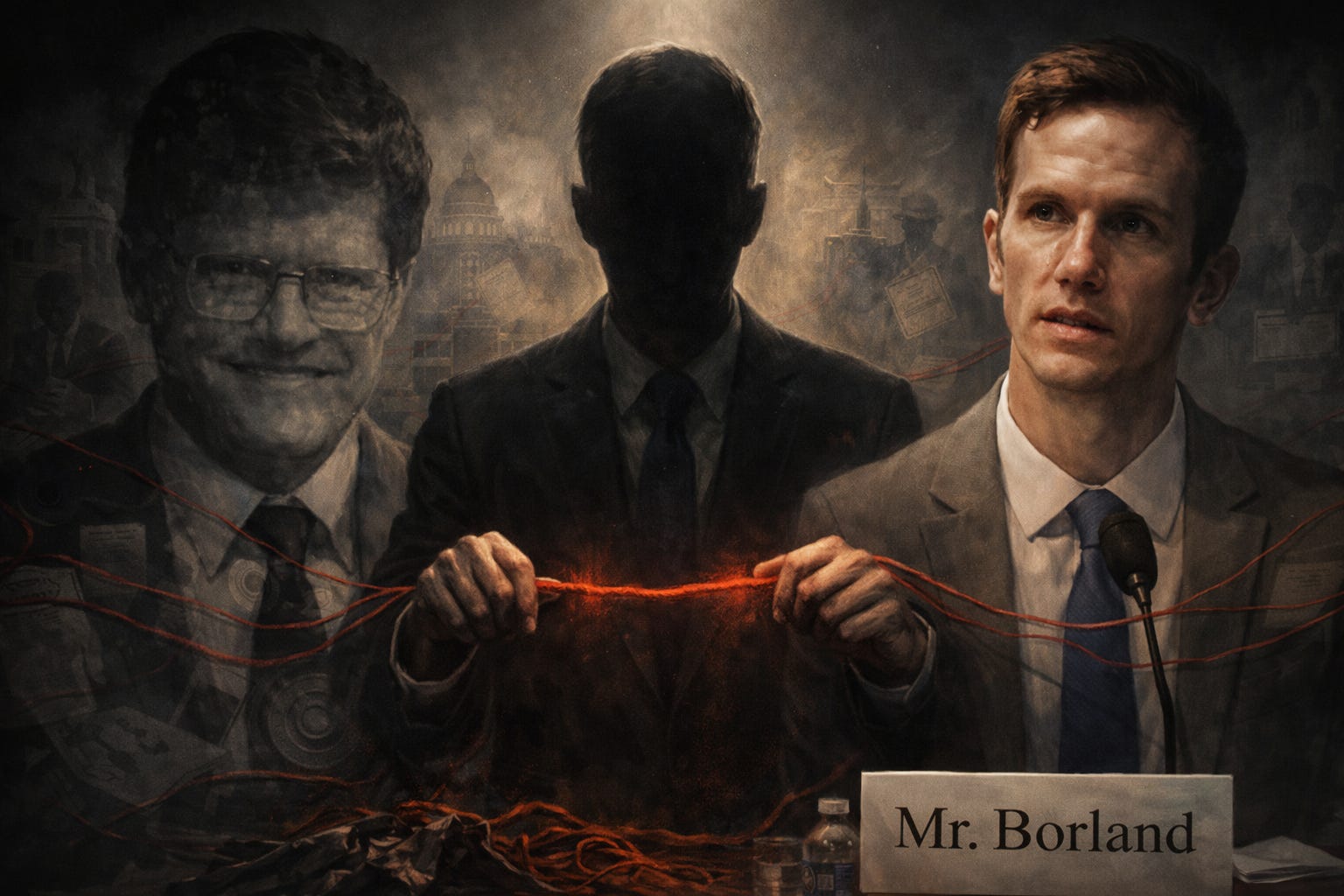
A forensic intelligence analysis reveals that Dylan Borland’s entire post-military career unfolded inside the exact institutional architecture that Dr. James Lacatski’s AAWSAP program. The connection is not a single dramatic link but a dense web of institutional, technical, geographic, and personnel overlaps that place both men on different nodes of the same classified intelligence pipeline. The most striking finding: AAWSAP specifically created a database of “any and all eyewitnesses to the sightings of unidentified aerial phenomena on and around Air Force Bases in the United States” and Borland was precisely such a witness.
Both employers land on the same $12.6 billion DIA contract
The single most architecturally significant connection is the SITE III contract, a $12.6 billion, 10-year IDIQ (Indefinite Delivery/Indefinite Quantity) contract administered by the Defense Intelligence Agency to provide “worldwide coverage for integrated IT intelligence requirements and technical support services” to both DIA and the National Geospatial-Intelligence Agency (NGA). Awarded in March 2021, SITE III encompasses 144 prime contractors across classified and unclassified networks and security domains.
Both of Borland’s post-military employers hold prime positions on SITE III. BAE Systems Technology Solutions & Services, where Borland worked approximately four years as a Senior Analyst, is a large-business prime contractor. Intrepid Solutions and Services, where Borland worked approximately six years, is also a large-business prime. Intrepid’s CEO Ryan Hebert stated upon the award that Intrepid had “supported DIA across various prime contracts over the past decade,” placing their DIA relationship back to approximately 2011; overlapping with AAWSAP’s operational period (2008–2010) and its immediate aftermath.
AAWSAP was a DIA program. Lacatski ran it from DIA’s Defense Warning Office (DWO-3). This means Borland spent his entire contractor career, roughly a decade, working for companies directly contracted to the same agency that administered the program Lacatski created. SITE III’s explicit dual mandate covering both DIA and NGA makes it the institutional bridge between Lacatski’s defense intelligence world and Borland’s geospatial intelligence world. Borland’s work at these contractors was, in the WEAPONIZED podcast’s description, “carried out at the direction of a particular intelligence agency,” an agency he has never publicly named but which the SITE III architecture strongly implies was DIA, NGA, or both.
Lacatski’s Air Force base witness database is the direct textual link
The most specific Lacatski statement connecting to Borland’s testimony appears in the DOPSR-cleared books. AAWSAP “initiated the creation of a database compiling the names, contact info and event details of any and all eyewitnesses to the sightings of unidentified aerial phenomena on and around Air Force Bases in the United States.” This database was part of the broader CAPELLA data warehouse, 260,000+ cases across 11 integrated databases, designed by Jacques Vallée, representing what Lacatski called “probably the largest UFO database that exists in the world.”
Dylan Borland is exactly the type of witness this database was designed to catalog. In summer 2012, while stationed at Langley Air Force Base as a 1N1 Geospatial Intelligence Specialist, Borland witnessed an approximately 100-foot equilateral triangular craft emerge near the NASA hangar on base at 0130 hours. The craft came within 100 feet of him, interfered with his phone, produced static electricity and an ozone-like smell, displayed a surface of “black metallic-flake paint”with flowing “gold-plasma fluid,” then accelerated to commercial jet altitude in seconds with zero sound, wind displacement, or kinetic disturbance. When he told colleagues, older enlisted personnel advised him to keep it quiet. The information was subsequently “labeled an extremely sensitive national security issue.”
While AAWSAP’s contract formally ended in December 2010, roughly two years before Borland’s sighting, Lacatski confirmed in Skinwalkers at the Pentagon that the database was not abandoned: “The authors are aware that the AAWSAP BAASS Data Warehouse, rather than lying fallow in a dusty warehouse or on a discarded hard drive, has been recently reactivated and is currently in use in various locations related to the government study of UAPs.” He separately confirmed the database “is currently being used by the U.S. military.” If the database continued collecting Air Force base UAP witnesses after AAWSAP ended, or if Borland’s sighting entered any DIA-adjacent reporting channel, his case would fall directly within the scope of Lacatski’s creation.
The Stratton pipeline runs from AAWSAP through NGA to Borland’s world
The personnel bridge between Lacatski’s AAWSAP and Borland’s GEOINT career runs through Jay Stratton, identified in the books under the pseudonym “Jonathan Axelrod.” Stratton worked alongside Lacatski at DIA’s Defense Warning Office and co-created AAWSAP’s field collection plans. His background was in electronic warfare engineering at Naval Sea Systems Command and foreign anti-ship missile seeker data analysis at the Office of Naval Intelligence, both sensor-exploitation disciplines directly adjacent to GEOINT tradecraft. At Skinwalker Ranch, Stratton “authored technical memoranda on sensor signatures recorded there.”
Stratton is the only person documented across all three successive UAP programs: AAWSAP (2008–2010), AATIP (informal Pentagon group), and UAPTF (2019–2022). While leading UAPTF, Stratton recruited David Grusch who served as the NRO’s representative to UAPTF from 2019–2021 and then became NGA’s co-lead for UAP analysis from late 2021 to July 2022. Grusch held the title of “Senior Technical Advisor for Unidentified Aerial Phenomena analysis/Trans-Medium Issues” at NGA before becoming the most prominent UAP whistleblower in June 2023.
This creates a direct, documented personnel chain: Lacatski (DIA/DWO → AAWSAP) → Stratton (DIA/DWO → AAWSAP → UAPTF) → Grusch (NRO → NGA/UAPTF) → the GEOINT/NGA contractor ecosystem where Borland worked. The analytical mission flows downstream from DIA threat assessment into NGA imagery exploitation; the precise pipeline Borland occupied at BAE Systems and Intrepid Solutions.
Another AAWSAP-adjacent figure underscores the sensor connection: Juliett Witt, identified in Skinwalkers at the Pentagon as a “Pentagon Operational Test and Evaluation Analyst and DoD Target Sensor Specialist” who participated in AAWSAP activities. “Target sensor specialist” work evaluates detection, tracking, and identification systems and is functionally adjacent to the electro-optical and radar imagery analysis that defined Borland’s career.
Archaeological digs, NGA LiDAR, and the buried craft
One of Borland’s most extraordinary claims from WEAPONIZED Episode 91 links directly to a documented NGA capability. Borland stated that in 2015, while at BAE Systems, he was exposed to briefings from members of a UAP legacy program who possessed “photographic evidence of archaeological digs” where “Tic Tac”-shaped craft had been recovered. Program personnel were told the objects found at such sites were “very old.”
NGA has a documented, publicly acknowledged program using Unmanned Aerial Systems equipped with Light Detection and Ranging (LiDAR) to survey archaeological sites. NGA’s own press materials describe deploying these systems at the Cahokia Mounds Historic Site in Illinois, with a geodetic surveyor stating: “The best part was applying our tradecraft in a way that is not the norm for us, in this case it was archaeology.” Liberation Times explicitly drew this connection, noting that “the National Geospatial-Intelligence Agency has employed Unmanned Aerial Systems and Light Detection and Ranging (LiDAR) technology to survey archaeological sites” in the same article reporting Borland’s archaeological dig claims.
If UAP retrieval operations have indeed occurred at archaeological sites, NGA’s LiDAR/UAS survey capability would be the precise tool for site identification and characterization. A GEOINT analyst like Borland, trained in interpreting exactly this type of sensor data, would be among the professionals most likely to encounter evidence of such operations within classified intelligence databases.
Twelve of the 38 DIRDs bridge directly into GEOINT
The 38 Defense Intelligence Reference Documents commissioned by Lacatski’s AAWSAP were structured as technology forecasts to 2050 across 12 technical domains, one of which was explicitly “Signature Reduction,” the inverse of GEOINT’s core detection mission. Understanding how to reduce signatures requires understanding the full electromagnetic detection chain (electro-optical, infrared, radar, multispectral, hyperspectral) that constitutes the GEOINT collection architecture Borland operated within. Senator Reid’s 2009 SAP request for AAWSAP specifically identified the need for individuals “specialized in the areas of advanced sciences, sensors, intelligence/counterintelligence.”
The single most direct technical bridge is DIRD #31: “Detection and High Resolution Tracking of Vehicles at Hypersonic Velocities.” This document addresses detection, tracking, and high-resolution imaging of objects at extreme speeds using radar and electro-optical/infrared sensor fusion, the capabilities central to NGA’s mission and to Borland’s professional specialty of “analyzing video, radar, and advanced electro-optical imagery.” At least 12 of the 38 DIRDs (roughly 32%) have direct or strong connections to imaging, sensor technology, or GEOINT-relevant capabilities, including DIRD #7 (Invisibility Cloaking), DIRD #22 (Metamaterials for Aerospace Applications), DIRD #27 (Laser Lightcraft Nanosatellites), and DIRD #34 (Cognitive Limits on Simultaneous Control of Multiple Unmanned Spacecraft).
AAWSAP’s operational activities further parallel GEOINT methodology. BAASS built a “functional prototype for an autonomous Unidentified Aerial Phenomena surveillance platform,” an ISR capability that directly prefigures AARO’s current GREMLIN sensor suite, which provides “hyperspectral surveillance” using 2D/3D radar, long-range electro-optical/infrared sensors, and multi-sensor data fusion. BAASS field investigators deployed with sensor kits including Canon 5D Mark II cameras, night vision equipment, infrared spotlights, Geiger counters, X-ray fluorescence analyzers, and handheld spectrum analyzers, a field-deployable version of multi-INT collection.
What Lacatski calls “security procedures,” Borland experiences as career destruction
Perhaps the most revealing conceptual connection lies in how both men describe the same classification infrastructure from opposite vantage points. On the October 2023 WEAPONIZED podcast, Lacatski stated: “I never saw what I would consider illegal activities. I saw security procedures that are paramount, but not illegal activities.” He validated Grusch’s claims as “reasonable” while declining to characterize compartmentalization as misconduct.
Borland, from inside the contractor ecosystem, describes those same “security procedures” as instruments of control and retaliation: forged and manipulated employment documents, colleagues directed not to speak with him, manipulation of security clearance records by “certain agencies” to block or delay classified employment, blacklisting from Intelligence Community agencies, and a November 2024 CI polygraph where he was asked to disclose details of his ICIG complaint during processing for a position “entirely unrelated to UFO/UAP matters.” On WEAPONIZED, Borland described people trapped in a “bureaucratic netherworld” where secrecy was maintained through “intimidation, excessive surveillance, death threats, and economic blackmail.”
Both independently described AARO in strikingly similar terms. Lacatski called AARO a “disinformation agency” and suggested it functions as a “counterintelligence operation.” Borland separately described AARO as a “phishing expedition to find out who knows what, not to move forward with an investigation.” These parallel characterizations from individuals at different levels of the system, program manager and field analyst, constitute independent convergence on the same institutional assessment.
The Immaculate Constellation hypothesis and where the threads converge
The alleged “Immaculate Constellation” program revealed in November 2024 by whistleblower Matthew Brown represents the apex of all these connections. Described as a USAP that “consolidates observations of UAPs by both tasked and untasked collection platforms,” it’s reported to include “high-quality imagery intelligence (IMINT) and measurement and signatures intelligence (MASINT)” of UAPs with “a verifiable chain of custody for UAP IMINT collected by U.S. military assets.” The Pentagon has denied records of this program.
Immaculate Constellation would operate precisely at the intersection of every thread in this analysis: DIA’s institutional authority over UAP programs (from AAWSAP forward), NGA’s GEOINT processing pipeline, the SITE III contractor infrastructure supporting both agencies, and the analytical workforce of 1N1 GEOINT specialists like Borland trained in “video, radar, and advanced electro-optical imagery.” Borland’s written congressional testimony stated he was “further exposed to classified information from the UAP legacy crash retrieval program through a sensitive position I held within a Special Access Program” without naming which SAP or which employer he was at during this exposure.
A single infrastructure, two perspectives
The connection between Lacatski and Borland is not a single smoking-gun statement but something potentially more significant: they describe the same institutional infrastructure from opposite ends. Lacatski built a DIA program that collected UAP sensor data, created the world’s largest UAP witness database specifically targeting Air Force base sightings, commissioned technical studies in detection and signature reduction, and saw the resulting data pipeline “reactivated” and integrated into ongoing government UAP study. Borland spent a decade inside the DIA/NGA contractor ecosystem at two companies that are both prime contractors on the same DIA contract, performing exactly the type of sensor-data analysis that AAWSAP’s outputs would require, and claims he was exposed to crash retrieval information through a SAP during that contractor career.
The most forensically significant specific connection is Lacatski’s DOPSR-cleared statement that AAWSAP created a database of “any and all eyewitnesses to the sightings of unidentified aerial phenomena on and around Air Force Bases” which he confirmed remains active and in military use. Borland is precisely such an eyewitness, at precisely such a base, whose sighting was labeled “an extremely sensitive national security issue.” Whether his report entered that database directly or through successor systems, the infrastructure Lacatski created was purpose-built to capture cases like Borland’s. The DIA administered the program that built the database. The DIA administers the SITE III contract where Borland worked. The pipeline is architecturally continuous; the only question is who else has connected the dots?
Gene Sticco ASIRP Dispatch · February 24, 2026